Outline 1.0 Introduction
- 1.1. The Auditory Dual-Stream Framework
- 1.1.1 classic visual model (two streams hypothesis)
- 1.1.2 state of the art in the auditory cortex (teaser for the theoretical part)
- 1.1.3 Introduction to dual stream processing
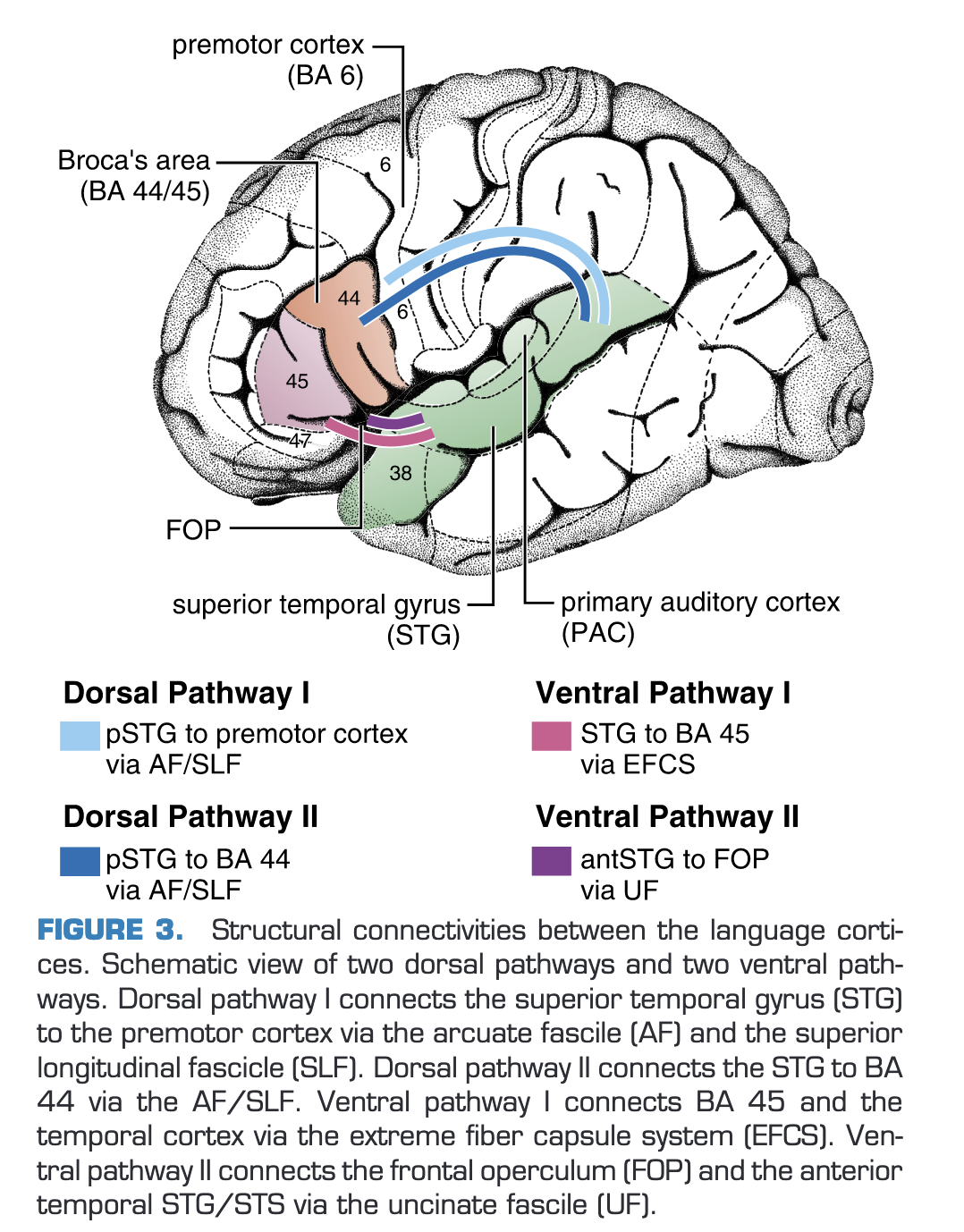
- vielleicht wie Friederici 2011 Figure 3.png
- Einführung in Hickok & Poeppel 2007 - Nature und Rauschecker & Scott (2009) - Nature Neuroscience
- 1.2 The Gap, Top-Down Control of Auditory Streams
- we know that those paths exist, but who controls them?
- Introduction Top-Down Attention
- comaprison to Bedini & Baldauf (2021)
- Ziel: Zeigen, wo die Forschungslücke liegt, gilt diese Aufteilung auch für das Hören?
- 1.3 Hypothesis, A supramodal organisation
- prefrontal organisation is supramodal
- FEF controls auditory dorsal stream
- IFJ controls auditory ventral stream
1.0 Introduction
1.1. The Auditory Dual-Stream Framework
The prefrontal cortex not only is the most important brain region for decision making, but also serves as the main hub for top-down attention. When we decide to look at the squirrel sitting on the table, it is our prefrontal cortex that first decides and then initiates the directing of the eyes and also the visual system to attend to the squirrel. While focusing on the squirrel, we hear the squirrel making noises - we then attend to the auditory stimuli as well. The question still remains which parts of the prefrontal cortex direct attention to the auditory stream. My thesis will examine the scope in which the prefrontal cortex directs attention top-down in different modalities. But first, we need to dive into the existing literature about the visual stream hypothesis.
1.1.1 The Visual Two-Streams Hypothesis
Lesion studies in macaque monkeys by Ungerleider and Mishkin (1982) set the start in developing the concept of parallel processing streams of the visual system in the brain. They described two distinct pathways that both originate in the primary visual cortex (V1): a ventral stream projecting toward inferotemporal cortex, processing objects such as a squirrel or the table. This stream is also called the ‘what’-stream and decodes object identity. The second, the dorsal stream, projects toward posterior parietal cortex and processes motion and object locations - also called the ‘where’-stream. Goodale & Milner (1992) later refined this framework, proposing that the dorsal stream is primarily involved in guiding how to interact with objects - while the ventral stream serves object perception and recognition. For our study it is relevant to ask whether the ‘how’/‘where’-stream not only performs visuomotor, but also audiomotor control over downstream modalities.
Critical for our study is recent work by Bedini and Baldauf (2021), identifying prefrontal hubs that perform top-down control over each stream. Based on evidence from functional and structural connectivity, they demonstrated a clear dissociation in functional connectivity: The Frontal Eye Field (FEF) - a core node of the Dorsal Attention Network (DAN)- shows predominant coupling with regions of the dorsal visual ‘where’-stream, while the anterior Inferior Frontal Junction (IFJa) - part of the Frontoparietal Network (FPN) - couples preferentially with the ventral visual ‘what’-stream. This connectivity-based division of labour was later supported by resting-state MEG data showing the same dissociation in oscillatory coupling and top-down directionality (Soyuhos & Baldauf (2023)). Together, these findings draw a clear picture of functional specialisation in prefrontal top-down control.
1.1.2 From Wernicke’s Area to Auditory Dual-Stream Processing
In the auditory modality, the processing of input was thought to operate in a single cortical region, Wernicke’s area. It is located in the posterior left superior temporal gyrus (STG) and was considered the primary hub for auditory comprehension following Wernicke’s (1874) findings in aphasia - the missing ability to understand language. This model dominated neuroscience well into the twentieth century.
In the 1970s and 1980s, when neuropsychological evidence revealed that lesions to the left STG did not consistently produce comprehension deficits, but were instead more reliably associated with speech production deficits (Hickok & Poeppel 2007 - Nature). These findings changed the view, so that auditory processing could not be reduced to a single region and led to a fundamental re-evaluation of the cortical auditory organisation.The current view, developed most influentially by Hickok & Poeppel (2004, 2007) and Rauschecker & Scott (2009), puts the organisation of the auditory cortex into two parallel processing streams analogous to those in the visual system. A posterodorsal stream projects from the superior temporal plane through parietal and premotor cortex and is associated with spatial processing and sensorimotor integration. An anteroventral stream projects from the STG forward through the temporal lobe toward inferior frontal regions and supports auditory object identification and semantic (speech) processing. Figure 1 illustrates this dual-stream architecture as proposed by Hickok & Poeppel (2007), mapping those two pathways onto a lateral view mainly of the left hemisphere. Section 3.2 ‘Selection of Regions of Interest’ will display in detail which regions most likely belong to which of both streams based on existing literature.
Link zum Original
Figure 1. Schema of the auditory dual-stream model (adapted from Hickok & Poeppel, 2007). The dorsal pathway (blue) extends from the superior temporal plane toward posterior parietal and premotor cortex. The ventral pathway (purple) projects anteriorly through the temporal lobe toward inferior frontal regions. Both streams originate in the primary auditory cortex on the supratemporal plane.
-Figure-1-dorsal-ventral-auditory-system-without-description.png)
1.2 The Gap, Top-Down Control of Auditory Streams
In environments with competing sounds, the brain cannot attend to all auditory input simultaneously. Top-down attention functions as a control mechanism that filters relevant information and suppresses distractors - therefore focussing on few inputs in a goal-directed manner (De Vries & Baldauf (2021) - Journal of Neuroscience). The key question is: Which prefrontal regions act as the top-down controllers of these auditory streams?
The division into dorsal and ventral pathways is well-documented(Ahveninen et al. (2006) - PNAS, Hickok & Poeppel 2007 - Nature), which already sets the path for following the question about the top-down attention mechanisms. Existing work has identified IFG subregions as frontal nodes in auditory processing, particularly BA44 and BA45 within the semantic pathway (Rolls et al. (2023) - Cerebral Cortex) and BA44 also along the dorsal pathway for affective prosody (Frühholz (2015) - NeuroImage). Hickok & Poeppel 2007 - Nature described a dorsal pathway including the Spt - a region at the parietotemporal boundary within the Sylvian fissure - as a sensorimotor interface, connecting anteriorly to Broca’s region and premotor cortex. Hickok & Poeppel 2007 - Nature. However, these findings remain specific to the language-related dorsal prosody processing or the semantic ‘what’-stream. Especially the auditory ‘where’-stream lacks a clear prefrontal controller. The question of whether the FEF and IFJa also direct the auditory domain in a similar fashion to the visual system remains unanswered.
Link zum Original
1.3 Hypothesis, A supramodal organisation
Following the thoughts if 1.1 and 1.2, we hypothesise that the resting-state functional connectivity will show a clear dissociation of the auditory ‘what’ and ‘where’-streams: the auditory ‘where’-stream preferentially connects to the Frontal Eye Field (FEF), and the auditory ‘what’-stream to the anterior Inferior Frontal Junction (IFJa).
If confirmed, this dissociation would provide evidence for a supramodal organisational principle of the prefrontal cortex, with FEF and IFJa acting as domain-general hubs for top-down attentional control across sensory modalities (Spagna et al. (2015)). This study tests a first step toward that larger claim by examining whether FEF and IFJa connectivity patterns in the auditory domain match those established for vision.
Link zum Original
see also
3.0 Methods
Type:
Tags:
Status:
Location:
Created: 2025-11-11 17:02